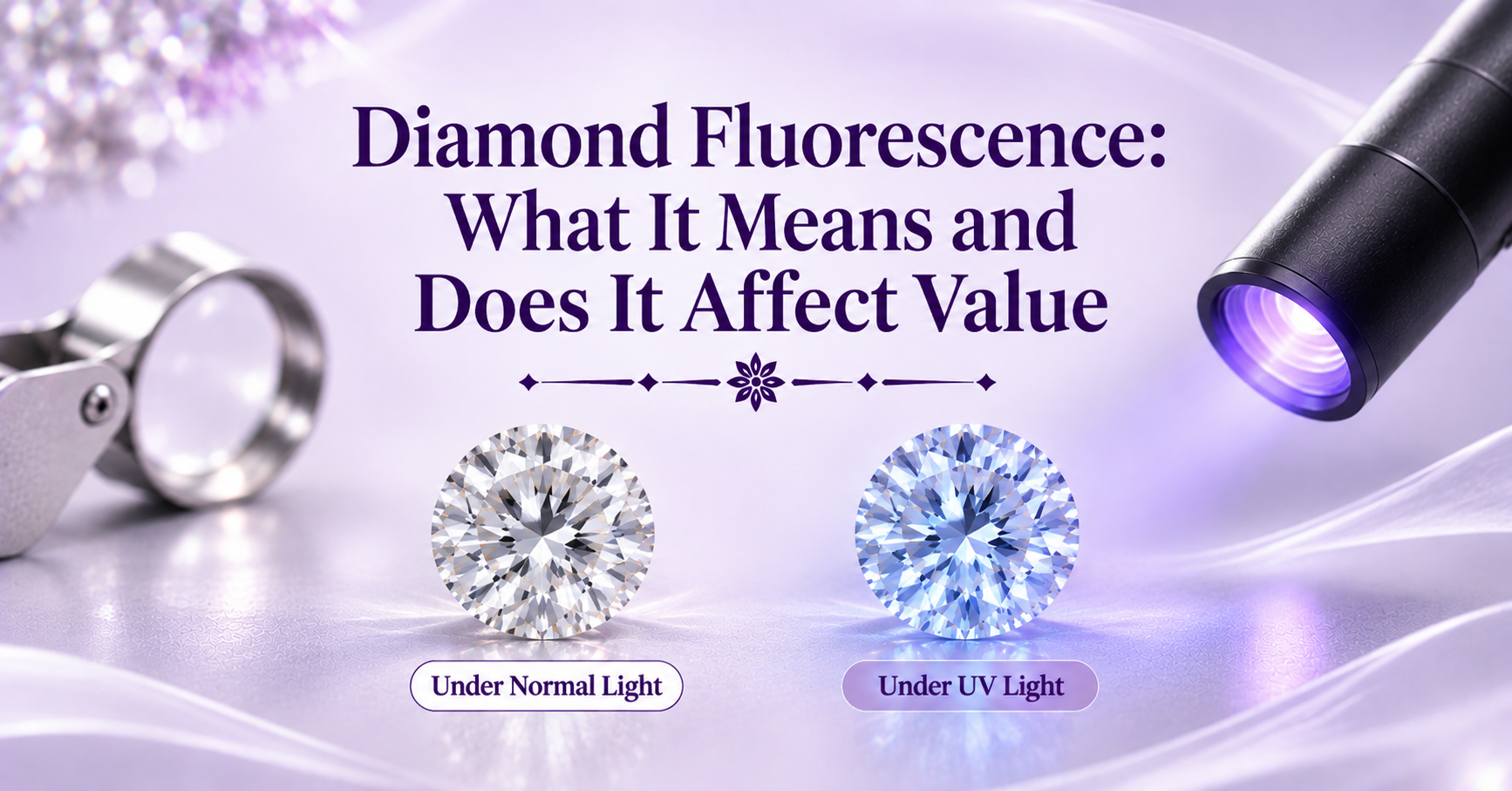
A diamond can look colourless under indoor lighting and glow blue when exposed to ultraviolet (UV) light. This effect is called diamond fluorescence. It is a natural optical property found in some diamonds, and it can influence how a stone looks under certain lighting conditions.
If you are buying a diamond ring, necklace or pair of earrings, you may have questions about fluorescence. Does it affect the diamond’s sparkle? Can it make a diamond look yellow or cloudy? Does it change the price?
The answers depend on the individual stone. Fluorescence is not automatically a sign of poor quality. Most fluorescent diamonds show little or no noticeable difference in appearance under everyday lighting. However, some stones may look different under strong UV light or sunlight.
In this guide, we explain what diamond fluorescence means, how laboratories assess it, and what buyers in India should consider before purchasing a diamond.
What Does Fluorescence Mean in a Diamond?
A fluorescent diamond glows when UV light hits it. The glow stops when UV light stops shining on the diamond.
Fluorescence is different from a diamond’s natural body colour. A diamond with a colour grade of D, for example, may still show blue fluorescence under UV light. The fluorescence does not automatically change its assigned colour grade.
It is also important to distinguish fluorescence from brilliance and fire. Brilliance refers to the white light reflected by a diamond, while fire describes the coloured flashes produced when light separates into different colours. Both depend heavily on the diamond’s cut and how it interacts with light.
To understand these effects in detail, read our guide on why diamond light performance matters.
What Causes Diamond Fluorescence?
Diamond fluorescence results from variations in a diamond’s atomic structure. Although diamonds consist mainly of carbon, some contain trace elements, structural defects or combinations of atoms and vacancies that interact with UV radiation.
When UV energy reaches these features, the diamond may emit visible light. The colour and intensity depend on the specific defects present in the stone.
Blue is the most common fluorescence colour in diamonds. Yellow, green, orange, white and other colours can also occur. These variations are one reason gemologists examine fluorescence when studying diamonds.
Fluorescence does not inherently weaken a diamond or make it less durable. It is a characteristic of how the stone responds to light, not an indication that the diamond is physically damaged.
Do Natural Diamonds Have Fluorescence?
Yes, natural diamonds can have fluorescence, but not all natural diamonds exhibit it. Gemological research shows that approximately 25–35% of diamonds examined show some degree of fluorescence under standard long-wave UV examination. Blue accounts for more than 95% of the observed fluorescence in those stones.
Natural diamonds form deep within the Earth under high pressure and temperature. Variations in their atomic structure can create the conditions needed for fluorescence.
The intensity varies from one diamond to another. Some show only a faint glow under UV light, while others produce a stronger reaction. Many natural diamonds do not show a visible reaction under standard long-wave UV examination.
When evaluating fluorescence, here are a few points to remember:
- Fluorescence does not determine whether a diamond is natural.
- Fluorescence is a natural characteristic that some diamonds possess.
- Blue is the most common fluorescence colour.
You can read more in our guide on how natural diamonds are formed.
How Is Diamond Fluorescence Graded?
Diamond fluorescence is not one of the 4Cs. It does not get a grade like colour or clarity. Labs treat it as an identifying feature.
They use a simple scale for fluorescence in diamond reports.
Fluorescence Strength | What it Means |
None | No noticeable fluorescence under the laboratory’s standard testing conditions. |
Faint | A weak reaction to UV light |
Medium | A moderate reaction that may be visible under UV lighting |
Strong | A pronounced reaction that is easier to observe under UV light |
Very Strong | A very intense reaction under UV light |
When comparing diamond certificates, look at fluorescence alongside the 4Cs. Also examine the actual stone under different lighting conditions instead of relying on the fluorescence grade alone.To understand every section of a certificate, read how to read a diamond grading report.
What Colour Is Diamond Fluorescence?
Diamond fluorescence can appear in several colours. The colour depends on the stone’s atomic structure and the way it responds to UV radiation.
Blue is by far the most common fluorescence colour. Other observed colours include yellow, green, orange, white and red. Different diamonds can display different colours and intensities, even when exposed to the same UV source.
Yellow Fluorescence in Diamonds
Yellow fluorescence is rare in natural diamonds. If you are considering a diamond with yellow fluorescence, inspect it under both ordinary lighting and UV light where possible. Check its colour grade, transparency and overall appearance before deciding whether it suits your preferences.
Does a Diamond Look Blue in Sunlight?
Yes, some diamonds can look blue in sunlight because sunlight has UV light. This is more noticeable in diamonds with medium to very strong blue fluorescence. Diamonds usually glow very little in sunlight, and they look blue only when UV light makes them glow strongly.
However, you may not always notice this reaction. Sunlight conditions change throughout the day, and glass, shade, clouds, and other surroundings can affect the UV radiation reaching the stone.
Fluorescence does not necessarily make a diamond appear blue to the naked eye in everyday sunlight. The glow may be subtle or difficult to distinguish from the light reflected by the diamond.
If you are buying a diamond in India, examine it under different lighting conditions, including daylight and indoor lighting.
How Does Diamond Fluorescence Affect Prices?
The relationship between diamond fluorescence and value is complex. It depends on the diamond’s colour grade, appearance, overall quality and market demand.
Some buyers prefer diamonds without fluorescence, particularly in higher colour grades. As a result, certain strongly fluorescent diamonds may sell at a discount compared with otherwise similar stones without fluorescence.
On the other hand, some buyers value blue fluorescence in diamonds with lower colour grades because it may improve their perceived whiteness in certain lighting conditions.
Fluorescence should therefore not be treated as a universal price penalty or advantage. Compare diamonds with similar carat weight, colour, clarity and cut, and assess their appearance before deciding which offers better value.
Does Fluorescence Affect Sparkle or Make a Diamond Look Cloudy?
A diamond does not sparkle because of fluorescence. Its sparkle mostly depends on its cut, not on whether it glows under UV light. Only in rare cases, a diamond with strong fluorescence can look slightly cloudy. This happens only when the stone has a flaw that scatters light, and fluorescence makes it easier to see. Most diamonds with fluorescence still look clear and bright. If you are unsure, check the stone in daylight before you decide.
Is Fluorescence Good or Bad in a Diamond?
Neither. Fluorescence is a characteristic, not a quality defect.
Whether it is desirable depends on the diamond’s appearance and your preferences. A fluorescent diamond can be an excellent choice if it looks attractive under the lighting conditions in which you usually wear it.
Consider these points before making a purchase:
– Look beyond the fluorescence grade. Assess cut, colour, clarity and carat weight first.
– Check the stone in person. Examine it in daylight and under indoor lighting.
– Look for haze or cloudiness. Pay particular attention to transparency if the diamond has very strong fluorescence.
– Compare similar stones. If possible, view diamonds with different fluorescence grades side by side.
– Review the grading report. Use the report to understand the diamond’s characteristics rather than judging it by one feature.
For buyers in India, the same advice applies whether you are purchasing an engagement ring, a diamond pendant or investment-oriented diamond jewellery. Focus on the stone’s documented characteristics, visible appearance and price.
Ultimately, a diamond with fluorescence can be just as appealing as one without it. The right choice is the one that meets your expectations for appearance and value.
For a step-by-step approach to choosing a stone, see our diamond buying guide.
Do Lab-Grown Diamonds Have Fluorescence?
Yes, lab-grown diamonds can have fluorescence. Like natural diamonds, they consist of crystalline carbon and can contain structural features that produce a reaction to UV light.
However, the fluorescence patterns and colours can differ depending on how a lab-grown diamond was produced and its specific growth characteristics.
Some lab-grown diamonds may show yellow, orange, green or other fluorescence colours under particular UV conditions. The response can vary significantly from one stone to another.
Natural vs Lab-Grown Diamond - How They Differ in Fluorescence?
Feature | Natural diamond | Lab-grown diamond |
Fluorescence | Some stones | Some stones |
Common fluorescence colour | Blue is the most common | Colours and patterns highly vary |
Does it confirm origin? | No | No |
Is professional testing useful? | Yes, it’s useful to assess characteristics. | Yes, it’s to assess characteristics and establish laboratory grown origin. |
Fluorescence vs Phosphorescence
Fluorescence and phosphorescence are related, but they differ in how long a material continues to emit light after exposure to an energy source.
With fluorescence, the visible glow generally stops almost immediately after the UV source is removed. A phosphorescent diamond keeps glowing briefly after the UV source is switched off, while a fluorescent diamond does not.
Feature | Fluorescence | Phosphorescence |
When does the glow appear? | While the diamond is exposed to the light source. | During exposure and after the source is removed |
What happens when UV light is switched off? | Glow stops immediately | Glow continues for some time. |
Can it occur in lab-grown diamonds? | Yes | Yes, particularly in some HPHT grown diamonds. |
Is it useful in gemology? | It characterises a diamond | Provides additional cues during professional identification |
How SGL Reports Fluorescence?
At SGL, every natural and lab-grown diamond report records fluorescence. We grade it from None to Very Strong. This helps you understand how the stone may behave in different lighting.
Here’s what you get with an SGL report:
- A clear fluorescence entry next to the other grades.
- A report that also covers the 4Cs, polish, symmetry, and a plotting diagram.
- A verified “Nature of Origin” field for natural or lab-grown stones.
- Security features such as a QR code, a 3D hologram, UV micro-text, and security paper.
- Free online verification with your report number.
A fluorescence grade provides useful information, but it does not tell you everything about a diamond’s beauty or value. Two diamonds with the same fluorescence grade can look different because of their cut, colour, clarity and other characteristics.
To see everything an SGL report includes, explore our natural diamond reports and lab-grown diamond reports.
Conclusion
Diamond fluorescence is a natural optical property that causes some diamonds to emit visible light under UV exposure.
Fluorescence does not automatically make a diamond better or worse. Most fluorescent diamonds show little noticeable difference under ordinary lighting, and the effect on value depends on the individual stone and buyer preferences.
Whether you are considering a natural diamond or a lab-grown diamond, check the grading report, compare the stone under different lighting conditions, and assess its overall appearance. Understanding fluorescence can help you make a more informed decision and choose a diamond that suits your preferences and budget.
If your diamond is already set in a ring, pendant or earrings, SGL also certifies diamond jewellery and lab-grown jewellery.
FAQs
Can two diamonds with the same fluorescence grade look different?
Yes. That’s because fluorescence is only one factor affecting appearance. Cut proportions, body colour, transparency and lighting conditions also influence how a diamond looks. Always compare the actual stones rather than relying on the fluorescence grade alone.
Does a diamond's fluorescence change over time?
Fluorescence is an intrinsic optical property, so ordinary wear does not change it. The visible glow depends on the UV source and the diamond’s characteristics.

Shatrughan Vishwakarma
Shatrughan Vishwakarma is an experienced Gems & Jewellery professional with 12+ years of expertise in Quality Assurance, Quality Control, and Education. Recognized for his technical knowledge and mentorship, he is committed to advancing quality standards and nurturing future industry professionals.