Diamond Encyclopaedia
Welcome to Diamond Encyclopaedia! Diamonds are said to be a woman’s best friend and her most prized possession. They are one of the hardest substances on earth with magnificent lustre. They have a crystalline appearance and can be of many fancy colours. An investment made in order to gain ownership of a diamond always wins against the test of time. Diamonds have an extremely high thermal conductivity. Diamond has been derived from the Greek word ADAMAS, meaning indestructible and invincible. They are also popularly known as 10th Anniversary Birthstones.
Formation of Diamonds

They are naturally occurring substances that are firmed within the earth’s crust at an approximate depth of 150-200km. They are homogenous in nature, which means they consist of only one element throughout, which is carbon. All the diamonds that are available to us in today’s world started to form billions of years ago, as their formation is an extremely slow process.
The 4Cs of a Diamond

This is an abbreviated form for all the necessary parameters to describe a diamond’s quality, characteristics and price. This standard is globally accepted and consists of the following:
- Colour: A scale starting from D (representation of the colourless form) to Z (representation of the most saturated form) is made, and each diamond is tested on it to check its colour. Naturally, most white diamonds in their crystalline form have a yellow tint in them. The closer the diamond is to D on the scale, the rarer it is.
- Clarity: The sparkle of diamonds can be hindered by blemishes in the diamond, whose amount, size, and placement vary from one piece to another. The phenomenon of refraction of light, which is the cause of the sparkle, gets disturbed by its presence, reducing its spark and clarity.
- Cut: This refers to the cause behind the exposure of certain faces of the diamond to light, causing it to sparkle. The direction of cutting, symmetry and proportions directly affect the brightness of a diamond. The better cut also symbolises good quality craftsmanship. This parameter is the only one that is affected by human hands and hence requires a lot of discipline in the field.
- Carat: Carat is a unit of weight and not its size. The value of the stone is in direct proportion to its carat weight. However, the price of the diamond is equally affected by the above-mentioned 3Cs combined as well.
Along with these, there is also another extremely important 5th C that doesn’t give us information about the diamond itself but is the most significant deciding factor about buying it. This factor is confidence. This certification tells us about the above 4Cs and makes it easier for the buyer to make a profitable purchase of their loose diamonds or diamond jewellery.
Popular Diamond Shapes

After mining and extraction of the diamond from the earth’s crust, it is a matter of human expertise to outshine the diamond by itself. There are many shapes in which a diamond can be cut. For example:
- Round brilliant cut: This shape is the most widely used and sold because of its maximum brightness. It is there in the markets and spreading exponentially since the 17th century. It is mainly used as engagement rings, earrings and pendants which leads to it being about 75% of the total diamonds sold.
- Oval cut: The famous and priced diamond of Kohinoor that is also historically valued itself is an oval-shaped diamond. This diamond was discovered in India, but it is now in the UK after many battles that are just pages in history books. Hence, it can be estimated that this shape is one of the oldest and has been around since the early 13th century.
- Princess cut: This cut gained immense popularity during the 1980s. It is one of the most unconventional cuts of all time. This square diamond is also comparatively more economical due to its lesser production of rough waste. This reduction is about 80% when compared to the other shape cutting.
- Cushion cut: Formerly known as the old mine cut, this cut is now regaining its popularity and base in the market. This cut may seem modern and thought to be one to the newer ages, but its footprints lead us back to the 17th century period. Many magnificent and popular diamonds of all times, like the Hope diamond, the Regent Diamond, The yellow Tiffany Diamond and the Napoleon Diamond, all fall under this category.
- Emerald cut: It is sought to be the more modernized form of the cushion cut diamonds, which has comparatively softer edges and a broader head. Its classic elegance makes it the right fit as an engagement ring.
Diamonds of historical importance

Differences between a real and fake diamond

Due to the high demand for diamonds and their high rates, many types of fake diamonds are sold in the market. One should always be very careful before investing in diamonds. Our blog – Importance of Diamond grading report will be a great read for you!
Fake diamonds can also be broadly distinguished into synthetic diamonds and imitation diamonds. Here are a few differences between the above-mentioned two types of diamonds:
- Formation determination: Real diamonds are 100% naturally formed within the lithosphere. The other ones are made using hydrogen, carbon gases, glass and other cheaper products.
- Light and refraction: Real diamonds have white and grey lights that are seen as sparkles. On the other hand, rainbow light, due to the complete diffraction of light and formation of a spectrum, is seen inside a fake diamond.
- Scratches or damage: Natural diamonds will not have any scratches, irrespective of the time it has been put to use. However, fake diamonds start to deteriorate with age and usage.
- Heat conduction: Natural diamonds are good conductors of electricity, even though they are completely made of a non-metallic element. It is the opposite way around for fake diamonds that do not conduct electricity.
Tests to spot a fake diamond
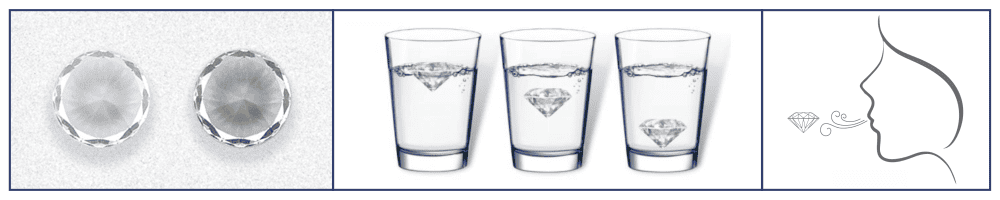
- The sandpaper test: Sandpaper is easily available in a household. Along with its other utilities, it can also determine the purity of a diamond. The sandpaper will not affect a natural diamond but will ruin the fake one due to the scratches that will be caused due to rubbing.
- The Water test: Natural diamonds have comparatively higher density and hence sink when dipped in water. Hence a synthetic diamond will float on the water’s surface, proving its worth.
- The Fog test: Natural diamonds are bad conductors of heat and hence will not let fog settle on their surface, and it will disappear quickly. If the mist remains for about 3-4 seconds, there is a high chance that it is a fake diamond.
FAQs
- Usage in jewellery: this is the most widespread use of diamonds and the primary factor for its high demand. It is fit for this role due to qualities like lustre and durability.
- Usage in industry: Since diamonds are tough, they are also used to make blades for high-tech industries. It is helpful in drilling, grinding or cutting materials.
- Usage in beauty products: with the growth of the skin and body industry, researchers have also found out about the great capability of diamonds to be used as a face exfoliator. Even though their costs are high due to the usage of diamond dust, they are extremely beneficial.