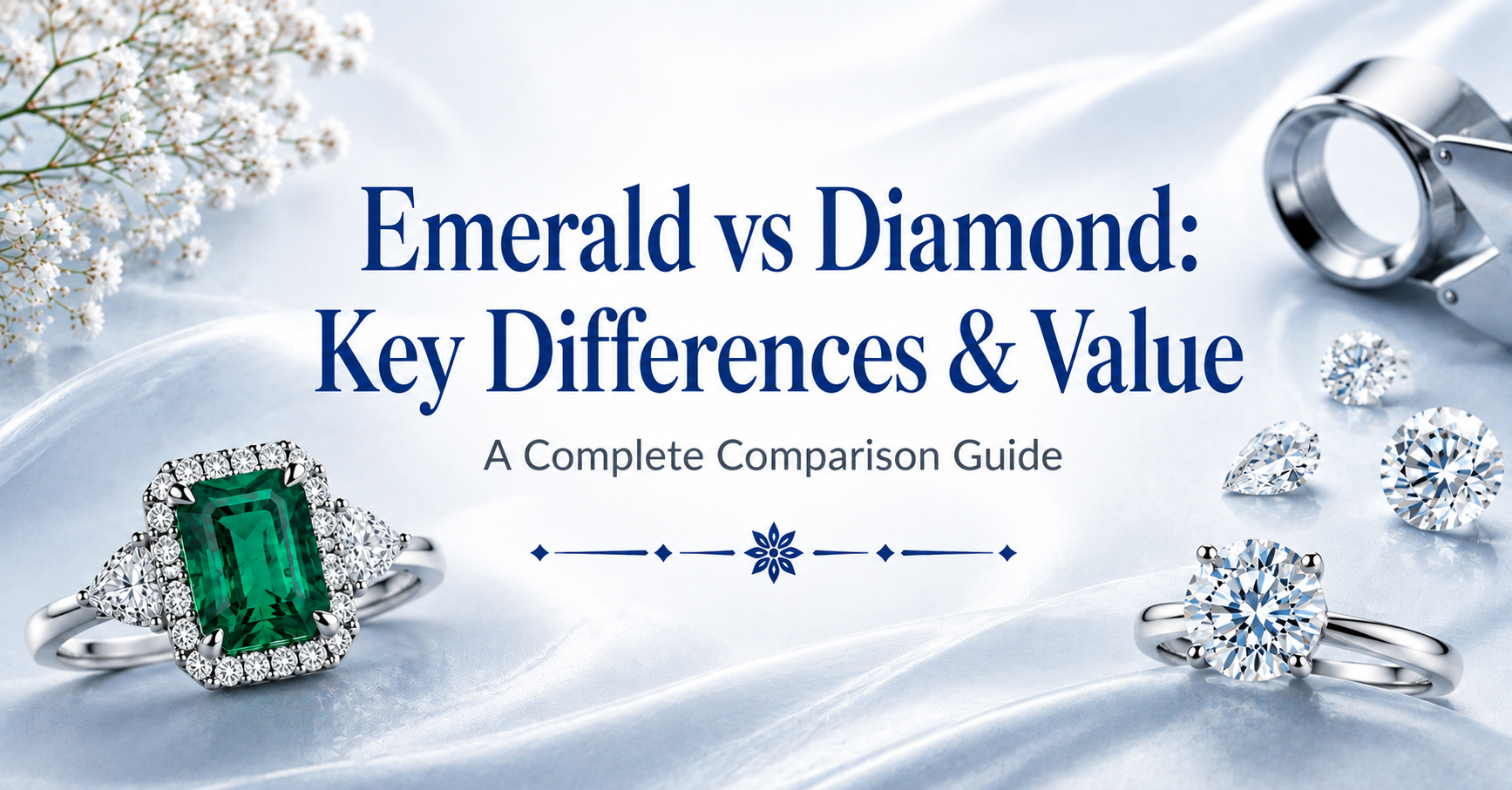
Diamonds and emeralds are among the most recognised and sought-after gemstones in the world. They differ significantly in their appearance, mineral composition, and properties. Their value also varies, despite both being used for fine jewellery. Although their applications are similar, they are evaluated using different standards.
The real emerald vs diamond comparison isn’t restricted to colour. Gemmologists review factors like hardness, optical properties, rarity, and origin to assess gemstone quality and determine long-term value and durability. Diamonds are primarily evaluated using the 4Cs, while emeralds are assessed based on factors such as colour, transparency, clarity, treatment, and origin.
Let’s dive into the difference between emerald and diamond.
What is an Emerald?
An emerald gemstone is green in colour and a variant of the mineral beryl (Be₃Al₂Si₆O₁₈). Its alluring green colour can be attributed to trace amounts of chromium, vanadium, or a combination of both. The intensity and uniformity of this green colour are among the most important factors affecting quality. Gemologists evaluate emerald colour based on hue, tone, and saturation.
Emeralds have natural characteristics or inclusions often referred to as jardin (French for “garden”) because of their moss-like appearance when magnified. Gemologists value these as natural formations rather than defects.
Surface-reaching fractures are common in emeralds, and clarity enhancement using colourless oil or resins is therefore a common treatment. Reputable gemological laboratories identify and disclose these treatments during examination.
The world’s most recognised sources include:
- Colombian emerald: Known for vivid green colour, high saturation, and exceptional transparency. Mines such as Muzo, Chivor, and Coscuez produce some of the finest emeralds.
- Zambian emerald: Typically displays a slightly bluish-green hue with excellent clarity and strong durability. These stones have become increasingly significant in the global market.
They are also commercially sourced from Brazil, Ethiopia, Afghanistan, Madagascar, Pakistan, and Zimbabwe.
What is a Diamond?
A diamond gemstone is composed of carbon atoms arranged in a cubic crystal formation. It is formed within the Earth’s mantle under extremely high pressure and temperature. It then reaches the surface through volcanic activity.
Diamonds are known for their hardness and brilliance. They have unique optical performance, with a high refractive index and strong dispersion, enabling them to reflect and separate light efficiently, producing the sparkle and coloured flashes associated with well-cut diamonds. Diamonds are mostly colourless, but they naturally occur in yellow, pink, blue, green, brown, black, and other fancy colours. Diamonds, however, go through more thorough grading using internationally recognised standards.
Diamonds can be natural or laboratory-grown. Both have the same chemical properties and crystal structure. Independent laboratory testing can distinguish between their origins.
Emerald vs Diamond: Key Differences
Feature | Emerald | Diamond |
Mineral Group | Beryl | Native Carbon |
Chemical Composition | Be₃Al₂Si₆O₁₈ | Carbon (C) |
Crystal System | Hexagonal | Cubic |
Typical Colour | Green | Colourless to Fancy Colours |
Main Value Factor | Colour | 4Cs |
Hardness (Mohs) | 7.5–8 | 10 |
Typical Inclusions | Common | Varies by clarity grade |
Common Treatments | Oil or resin clarity enhancement | May include HPHT or fracture filling in some diamonds |
Optical Characteristic | Rich body colour | Brilliance, fire and scintillation |
Major Sources | Colombia, Zambia, Brazil, Ethiopia | Botswana, Canada, South Africa, Russia, Australia and other producing regions |
Hardness & Durability Comparison
Hardness and durability may be related but are not interchangeable. They depict different properties. Hardness refers to a mineral’s ability to resist scratching. Durability is more about resistance to chipping, fracture, or breaking during everyday wear.
Property | Emerald | Diamond |
Mohs Hardness | 7.5–8 | 10 |
Scratch Resistance | High | Excellent |
Resistance to Impact | Moderate | Good, but susceptible to cleavage |
Internal Fractures | Common | Less common in high-clarity stones |
Everyday Wear | Requires greater care | Suitable for frequent wear |
According to the Mohs hardness scale, diamond is the hardest naturally occurring mineral with a hardness of 10. But hardness does not make the gemstone indestructible; it possesses an octahedral cleavage that allows sharp impacts along specific crystallographic planes to cause it to split.
Emerald hardness is slightly lower – approximately 7.5 to 8. This provides good scratch resistance. Their natural inclusions and fractures make them more vulnerable to chipping if subjected to sudden impact. This is why emerald jewellery requires a certain level of care and protection.
Beauty & Visual Appeal
The differences in the appearance of emeralds and diamonds are largely due to their different optical properties. Diamonds are chosen for their brilliance, fire, and glitter. These effects depend on cut quality, which determines how efficiently light enters and exits the stone. A well-proportioned diamond produces greater brightness and sparkle than a poorly cut stone, even if both have identical colour and clarity.
Emeralds are attractive due to their brilliant colour. It is among the most desirable stones known for its rich display and even green saturation and transparency. Unlike diamonds, emeralds are not expected to produce intense sparkle. Instead, their beauty lies in depth of colour and natural character.
Gemologists evaluate emerald colour based on three components:
- Hue
- Tone
- Saturation
For high-quality emeralds, colour generally has the greatest influence on value. Even small differences in saturation or transparency can significantly affect an emerald’s market value.
Emerald vs Diamond: What Affects Their Value?
Certain factors directly influence the value of these respective stones.
Emerald Value Factors
An emerald gemstone is primarily evaluated using:
- Colour intensity
- Transparency
- Clarity characteristics
- Cut quality
- Carat weight
- Geographic origin
- Presence and extent of clarity enhancement
Fine emeralds displaying vivid green colour with minimal treatment are relatively uncommon and command premium prices.
Diamond Value Factors
A diamond gemstone is graded according to the internationally recognised 4Cs:
- Carat
- Colour
- Clarity
- Cut
These grading parameters allow consistent comparison across diamonds of different sizes and qualities.
For a detailed explanation of the 4Cs and how they influence diamond quality, see our complete guide to the 4Cs of diamonds.
Origin & Rarity
The source of the gemstone really weighs in heavily while determining the quality of the product. Origin plays an especially important role in emerald identification and valuation.
Colombian Emerald vs Zambian Emerald
Both origins produce high-quality emeralds. They often display different gemological characteristics.
Colombian emeralds are recognised for:
- Pure, vivid green colour
- High saturation
- Excellent transparency
- Historic significance
Zambian emeralds typically exhibit:
- Bluish-green colour
- Good clarity
- Higher iron content
- Strong durability for jewellery applications
There is no definitive way to determine if one origin is better than the other. However, laboratories determine origin by analysing inclusion patterns, trace element chemistry, and other gemological characteristics rather than colour alone.
Diamonds are generally valued based on grading characteristics rather than geographic origin. However, provenance may be significant in certain exceptional or historical stones.
Diamond Grading Basics: Understanding the 4Cs
The internationally accepted system for evaluating diamonds is based on the 4Cs of diamonds.
Carat
Carat measures weight rather than physical size. Larger diamonds are generally rarer, but value also depends on the remaining grading factors.
Cut
Cut refers to proportions, symmetry, and polish. It directly influences brilliance and light performance.
Colour
Most colourless diamonds are graded from D (colourless) to Z (light yellow or brown). Higher colour grades generally command greater value. Fancy-colour diamonds are evaluated using separate grading systems.
Clarity
Clarity assesses internal inclusions and external blemishes under magnification. Diamonds with fewer clarity characteristics generally receive higher clarity grades.
Together, these factors provide a standardised framework for comparing diamonds objectively. Learn more about SGL’s diamond reports and certification services.
Why Certification Matters for Emeralds and Diamonds
Visual examination alone may be inconclusive in determining a gemstone’s identity, treatments, origin, or whether a diamond is natural or laboratory-grown. An independent gemstone certification lab examines gemstones using specialised instruments and internationally accepted testing methods to establish their identity and quality.
For emeralds, laboratory analysis may determine:
- Natural or synthetic origin
- Presence of clarity enhancement
- Extent of treatment
- Geographic origin, where determinable
- Identification of simulants or imitations
For diamonds, laboratory reports document:
- Carat
- Colour
- Clarity
- Cut
- Fluorescence
- Proportions
- Symmetry
- Polish
- Natural or laboratory-grown origin
- Detection of treatments where applicable
Independent laboratory reports provide documented information that supports transparency throughout the gemstone trade. Institutions such as SGL Laboratories perform these evaluations using established gemological testing protocols. Learn more about SGL’s gemstone reports and certification services.
For a deeper understanding of diamond certification and grading reports, see our complete guide to diamond certification.
Which One Should You Choose?
The one who wears it ultimately decides based on the characteristics they prefer. A diamond may be preferred if durability, brilliance, and standardised grading are primary considerations. Its exceptional hardness makes it well-suited for jewellery worn daily.
An emerald becomes the go-to choice for its distinctive green colour, rarity, and natural character. Each emerald possesses unique internal features formed during geological growth, giving every stone an individual appearance.
Rather than comparing which gemstone is objectively “better,” it is more useful to evaluate each stone on its own gemological quality, treatment status, and certification. Intended use should also be considered when choosing between the two.
Conclusion
The difference between emerald and diamond is stark and extends far beyond appearance. They differ in mineral composition, optical behaviour, durability, grading methods, rarity, and value assessment.
Diamonds are evaluated primarily using the 4Cs of diamond, while emeralds are judged largely on colour, transparency, clarity characteristics, treatment, and origin. Their market value draws from these distinct evaluation systems rather than a simple comparison.
Whether assessing an emerald gemstone or a diamond gemstone, an independent laboratory examination provides reliable, authentic information. It helps confirm the gemstone’s identity, quality, treatments, and authenticity, allowing buyers to make an informed, well-documented decision.
For customers in Dubai, SGL’s Experience Center in Deira offers professional diamond certification services and expert gemological support.
FAQs
What is an emerald?
An emerald is the green variety of the mineral beryl. Its colour is caused by trace amounts of chromium, vanadium, or both.
Is emerald more expensive than diamond?
Not necessarily. The answer depends on quality. Fine untreated emeralds can be more valuable per carat than many diamonds, while commercial-quality diamonds may cost more than lower-grade emeralds.
What is the hardness of an emerald?
On the Mohs hardness scale, emerald has a hardness of approximately 7.5 to 8, making it resistant to scratches but more susceptible to chipping than a diamond.
Why are Colombian emeralds more famous than Zambian emeralds?
No. Both origins produce outstanding gemstones. Individual quality is determined by colour, transparency, clarity, treatment, and laboratory examination rather than origin alone.
How are diamonds graded?
Diamonds are graded using the internationally recognised 4Cs: Carat, Colour, Clarity, and Cut. Additional characteristics such as fluorescence, proportions, symmetry, and polish may also be documented.
Why is gemstone certification important?
Independent laboratory certification verifies a gemstone’s identity, quality, treatments, and, where possible, geographic origin. For diamonds, certification also confirms whether the stone is natural or laboratory-grown, promoting transparency and confidence throughout the gemstone trade.