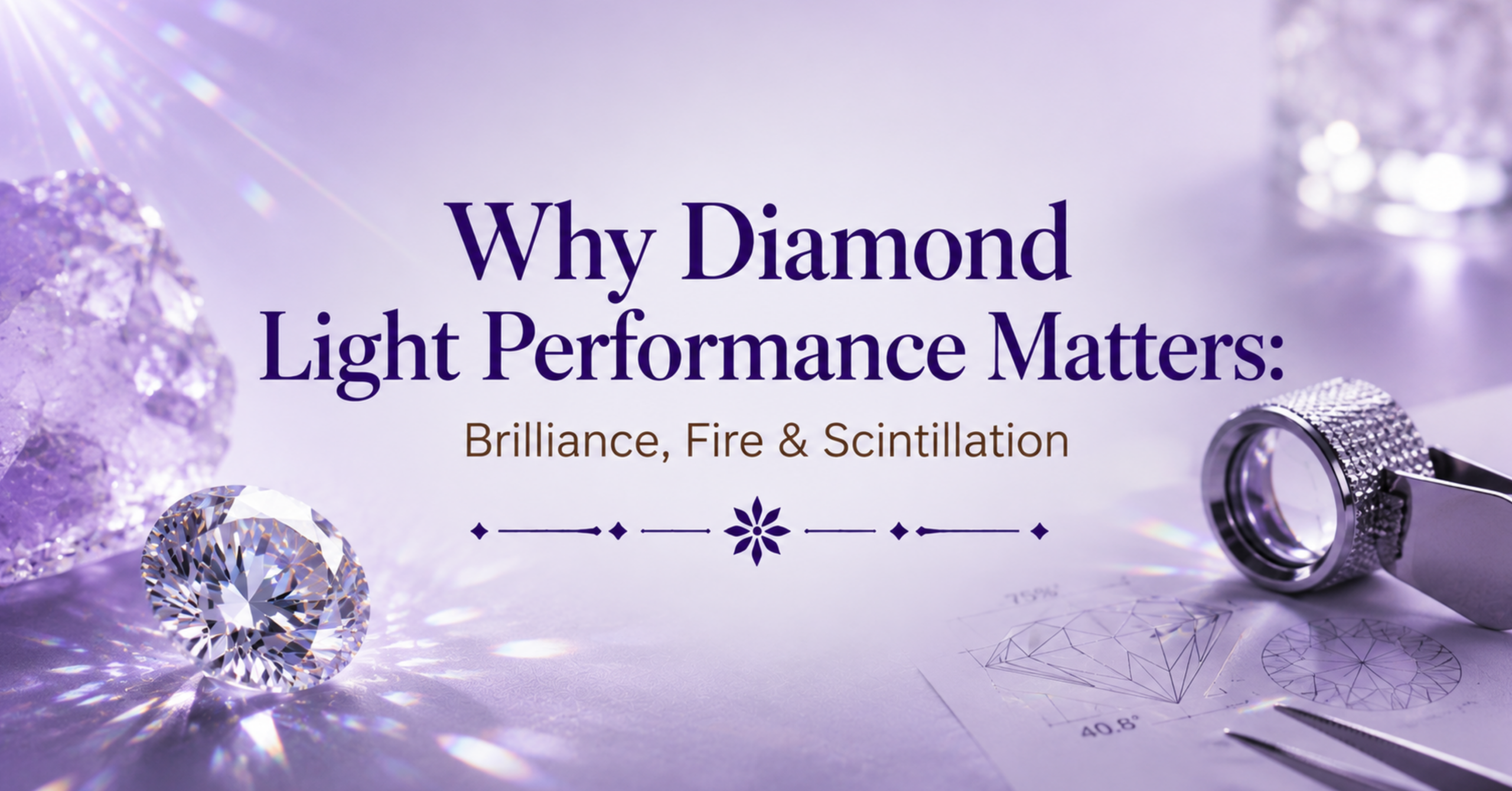
A diamond’s beauty is strongly influenced by the way it interacts with light. Its colour and clarity contribute to its overall appearance. However, its true visual appeal relies heavily on the quality of that interaction.
Simply put, the multiple facets of a diamond control how light travels through the stone and returns towards the observer. This produces several visual effects, including diamond brilliance, diamond fire, and diamond scintillation. The pattern of light and dark areas also contributes to the overall appearance through contrast.
This is why two diamonds with similar carat weight, colour, and clarity can still look different. Their proportions, facet angles, symmetry, and cut quality can change how efficiently they handle light. The surrounding lighting environment also affects what the observer sees.
Understanding diamond light performance helps explain a basic question often asked by buyers: why do diamonds shine? The answer lies in the interaction between the diamond’s optical properties and its cut.
What Is Diamond Light Performance?
Diamond light performance describes how effectively a faceted diamond interacts with light and returns it towards the observer. It includes the different visual effects produced by the diamond’s optical properties.
A diamond’s refractive index is approximately 2.42 for visible light. This relatively high value causes light to bend significantly when it enters and leaves the diamond. The pavilion facets can also redirect light within the stone before it returns through the crown.
The angles and positioning of the facets determine whether light is returned efficiently or escapes through the pavilion and other areas. A well-cut diamond can have proportions and facet arrangements that improve light return and create attractive patterns of brilliance and scintillation. Poorly cut diamonds fail to give a balanced look due to loss of light and visual appeal.
However, attractive diamond light performance is not determined by light return alone. The balance of brightness, contrast and the changing pattern of light and dark areas also contributes to the diamond’s overall visual appearance.
Lighting conditions can also influence how a diamond’s light performance is perceived, with different light sources highlighting different visual effects.
Do Diamonds Shine or Reflect?
One of the most common questions about diamonds is: do diamonds shine or reflect?
Diamonds do not produce their own light. Their appearance comes from how they interact with external light through reflection, refraction, and dispersion. The sparkle we see is created as light enters the diamond and is redirected and returned towards the observer by its facets.
When it comes to diamonds, both refraction and brilliance are important. Facets reflect light back towards the observer, while refraction changes the direction of light as it travels between air and diamond. Dispersion separates some white light into its component colours, contributing to the appearance of fire.
This is also why diamonds cannot sparkle in complete darkness. They require an external light source. The quality of the cut determines how effectively the stone uses the available light.
The amount and direction of available light also influence the visual effect. A diamond under a large, diffuse light source may look bright but show less distinct scintillation. Under multiple small light sources, the same diamond may display frequent flashes of white and coloured light.
What Is Diamond Brightness?
Diamond brightness refers to the overall brightness a diamond displays when viewed by an observer. It is largely influenced by how effectively the diamond’s facets reflect and return light towards the observer. Brightness depends on how the diamond’s facets are positioned and how they interact with incoming light. The table, crown, and pavilion work together to control the path of light through the stone. However, it must be noted that brightness and scintillation are two separate factors.
A diamond with good proportions can return a substantial amount of light towards the observer. Poor proportions can cause some light to escape through the pavilion instead of returning through the crown. This is known as light leakage and can make the diamond appear less bright.
However, it must be noted that brightness and scintillation are two separate factors. A diamond can appear bright under diffuse lighting without producing many noticeable flashes. Scintillation depends on changes in the light-and-dark pattern as the diamond, light source, or observer moves.
What Is Diamond Fire?
Diamond fire is the coloured flashes produced when white light is dispersed into its spectral components. Dispersion occurs when the refractive index of diamond varies slightly with wavelength. As different wavelengths travel through it, they bend by different amounts. This separates white light into colours that may appear as red, blue, yellow, and other spectral flashes.
Facet geometry affects how much diamond fire you can see. Crown height, crown angle and other proportions change the way light moves through the stone. Lighting also makes a difference. Small, direct light sources can make coloured flashes easier to see than broad, diffuse light.
However, a diamond displaying strong fire is not necessarily superior in every other aspect of light performance.
Brilliance vs. Brightness: Are They the Same?
The terms brilliance and brightness are sometimes used interchangeably in the diamond trade. However, they can have different meanings depending on the terminology or assessment system being used.
Brightness generally describes the amount of white light perceived from a diamond.
Brilliance can refer more broadly to the overall visual effect associated with white-light return and the diamond’s appearance.
What Is Diamond Scintillation?
Diamond scintillation is the changing pattern of light and dark areas seen when the diamond, observer, or light source moves.
Unlike brilliance, scintillation involves movement and change. As the diamond, observer, or light source moves, the pattern of light and dark areas changes. This creates the dynamic flashes commonly associated with diamond sparkle.
Facet size and arrangement influence the character of scintillation. Some diamonds produce larger, broader flashes, while others display many smaller flashes. Neither pattern is automatically superior. The visual effect depends on the diamond’s cut style and the balance of its facet arrangement.
A diamond with good scintillation shows a balanced pattern of light and dark areas rather than random flashes. Symmetry and proportions also affect how these reflections appear as the diamond moves.
What Is Diamond Contrast?
Diamond contrast refers to the pattern of bright and dark areas visible across the face-up view of a diamond. Dark areas do not always indicate poor cut quality. A balanced contrast pattern can contribute to scintillation because changes between light and dark areas create the flashes seen as the diamond moves. Without this contrast, a diamond can look flat.
The important factor is balance. Excessive or poorly distributed dark areas can reduce perceived brightness. In some diamonds, unsuitable proportions can create persistent dark zones or patterns that affect face-up appearance.
Contrast can also change with the observer’s position and the surrounding environment. A person viewing a diamond may see reflections of darker objects, clothing, or the surrounding setting within its facets. This is one reason why a diamond’s appearance cannot always be judged from a single lighting condition.
Brilliance vs Fire vs Scintillation vs Contrast
Property | What It Means | Main Optical Effect | Key Influences |
Brilliance | Return of white light | Brightness | Cut, proportions, facet angles, lighting |
Fire | Dispersion of white light | Coloured flashes | Dispersion, crown geometry, lighting |
Scintillation | Change in light and dark reflections with movement | Sparkle and flashes | Facet arrangement, symmetry, movement |
Contrast | Distribution of bright and dark areas | Definition and visual pattern | Proportions, facet geometry, lighting |
These effects work together. A diamond with strong brilliance but weak scintillation may appear bright but less lively. Another diamond may show strong scintillation but poor light return if too much light escapes. Good diamond light performance therefore depends on how these optical effects interact rather than on one feature alone.
What Affects a Diamond's Light Performance?
Several factors influence how a diamond handles light.
Cut and Proportions
Cut is one of the most important factors. The angles and proportions of the crown, pavilion, table, girdle, and other components determine the path of light through the diamond.
A shallow pavilion can allow light to escape through the bottom. An excessively deep pavilion can also reduce efficient light return. The relationship between different angles matters more than any single measurement.
Facet Arrangement
The number, size, shape, and arrangement of facets influence how a diamond reflects light. Different cutting styles create different patterns of brilliance and scintillation.
A round brilliant diamond, for example, has a facet arrangement designed to produce a particular balance of light return and optical effects. Round brilliant and fancy cut diamonds can show different patterns because their proportions and facet arrangements vary.
Symmetry
It is the accuracy with which the facets are all aligned. Poor symmetry can disturb the intended light pattern and create uneven areas of brightness or contrast. Hearts & Arrows diamonds are also associated with precise facet alignment and distinctive optical patterns.
Polish
Polish describes the quality of the diamond’s facet surfaces. Surface irregularities can affect how clearly light reflects from the facets.
Transparency
Light performance is not determined by external proportions alone. A diamond must also allow light to travel through the stone effectively. Certain internal characteristics can affect transparency and influence the diamond’s overall visual appearance.
Lighting Environment
A diamond’s appearance can vary under different lighting environments, with each type of light highlighting its brilliance, fire, and scintillation differently.
This is particularly important when assessing diamond sparkle. A diamond that appears highly active under several small light sources may look more subdued under broad, diffuse lighting.
Why Diamond Light Performance Matters When Buying
Carat weight alone does not tell you how bright a diamond will look. Two diamonds of the same weight can have different proportions and facet arrangements. As a result, they can have different levels of light performance.
When buying a diamond, consider the cut along with colour and clarity. Understanding the 4Cs of diamonds can also help buyers evaluate these factors more effectively. Whenever possible, view the actual diamond rather than relying only on numbers. A laboratory report can also provide useful information about the diamond’s grading and proportions.
It is worth viewing the diamond under different types of light. Spotlighting can bring out a diamond’s sparkle, while natural or diffuse light can give you a better idea of its overall brightness.
Conclusion
Diamond brightness refers to the amount of white light perceived from the stone. Brilliance can refer more broadly to the overall visual effect associated with white-light return and the diamond’s appearance. Diamond contrast helps create this visual pattern. These effects depend on the diamond’s refractive index, proportions, facet arrangement, and cut. Lighting directly impacts how you perceive a diamond. When buying a diamond, light performance is worth considering alongside the 4Cs. A diamond report or gemstone report can also provide useful information about the stone’s grading and proportions.
FAQs
Why do diamonds shine?
Diamonds shine because their facets reflect and refract external light back towards the observer. Their high refractive index and carefully arranged facets contribute to brightness and sparkle.
Do diamonds shine or reflect?
Diamonds reflect and refract external light rather than producing their own. As light passes through the facets, dispersion also splits some of it into spectral colours, which is what creates diamond fire.
What is diamond brilliance?
Diamond brilliance refers mainly to the perceived brightness created by white light returned from the diamond to the observer. Cut proportions and facet angles strongly influence brilliance.
What is diamond fire?
Diamond fire is the coloured flashes produced when white light is dispersed into its spectral components as it passes through the diamond.
What is diamond scintillation?
Diamond scintillation is the changing pattern of bright and dark flashes seen as the diamond, light source, or observer moves.
What is diamond contrast?
Diamond contrast is the distribution of light and dark areas visible in a diamond. A balanced contrast pattern can contribute to scintillation and visual definition.
What is a diamond's refractive index?
Diamond has a refractive index of approximately 2.42 for visible light. This high refractive index contributes to its ability to bend and redirect light within the stone.
Does cut affect diamond sparkle?
Yes. Cut proportions, facet arrangement, symmetry, and polish all affect how a diamond interacts with light. Poor proportions can increase light leakage and reduce the visual impact of brilliance and scintillation.
Can a diamond have strong brilliance but less fire?
Yes. Brilliance and fire are different optical effects. A diamond may return substantial white light while showing fewer coloured flashes depending on its proportions, facet geometry, and lighting conditions.
Can lighting change how a diamond looks?
Yes. Different light sources produce different visual effects. Directional lighting can increase visible flashes and scintillation, while diffuse lighting can produce broader and more even brightness.